Rule 35 and CCP 2032 Eye Examinations: A Guide to the Independent Ophthalmic Examination
Federal Rule of Civil Procedure 35 lets a court order a party whose physical condition is "in controversy" to be examined, but only on motion for good cause. In California, Code of Civil Procedure section 2032.220 lets a personal injury defendant demand one physical examination of the plaintiff without a court order, within 75 miles of the plaintiff's residence.

For claimed eye injuries, the exam is performed by an ophthalmologist (a physician and surgeon specializing in the eye), and several standard parts of it should be addressed in the demand or order.
This article is educational and is not legal advice. Attorneys should check current law in their jurisdiction.
Federal Rule of Civil Procedure 35
Rule 35(a)(1) provides that the court "may order a party whose mental or physical condition ... is in controversy to submit to a physical or mental examination by a suitably licensed or certified examiner."
Rule 35(a)(2) states that the order "may be made only on motion for good cause and on notice to all parties and the person to be examined" and "must specify the time, place, manner, conditions, and scope of the examination, as well as the person or persons who will perform it."
Rule 35(b) governs the report, which "must set out in detail the examiner's findings, including diagnoses, conclusions, and the results of any tests." On request, the moving party must deliver it with "like reports of all earlier examinations of the same condition." Requesting the report or deposing the examiner waives privilege as to all examinations of the same condition, and an undelivered report can lead to exclusion of the examiner's testimony.
California Code of Civil Procedure 2032.010 and Following
California's examination statute begins at section 2032.010. Section 2032.020(b) requires that a physical examination "be performed only by a licensed physician or other appropriate licensed health care practitioner."
CCP 2032.220: The demand examination
Under section 2032.220(a), in a personal injury case "any defendant may demand one physical examination of the plaintiff" if both conditions are met:
- "The examination does not include any diagnostic test or procedure that is painful, protracted, or intrusive."
- "The examination is conducted at a location within 75 miles of the residence of the examinee."
The demand must "specify the time, place, manner, conditions, scope, and nature of the examination, as well as the identity and the specialty, if any, of the physician" (2032.220(c)), and the exam must be set at least 30 days after service (2032.220(d)). The plaintiff responds within 20 days by agreeing, agreeing as modified, or refusing with reasons (2032.230).
CCP 2032.310 and 2032.320: Court-ordered examinations
Any other physical examination, including a second one, requires leave of court (2032.310), granted "only for good cause shown" (2032.320(a)). The order must specify the examiner and the "time, place, manner, diagnostic tests and procedures, conditions, scope, and nature of the examination" (2032.320(d)). An exam more than 75 miles away requires good cause for the travel and advancement of the examinee's travel costs (2032.320(e)).
CCP 2032.510 and 2032.530: Observers and recording
At a physical examination, the examinee's attorney or the attorney's representative "shall be permitted to attend and observe" and "to record stenographically or by audio technology any words spoken to or by the examinee" (2032.510(a)). The observer "may monitor the examination, but shall not participate in or disrupt it" (2032.510(b)), and may suspend it if the examiner "undertakes to engage in unauthorized diagnostic tests and procedures" (2032.510(d)).
Section 2032.530 addresses audio recording of mental examinations; an eye exam is a physical examination governed by 2032.510.
CCP 2032.610: The report demand
The examined party may demand "a detailed written report setting out the history, examinations, findings, including the results of all tests made, diagnoses, prognoses, and conclusions of the examiner" (2032.610(a)). Reports are due "within 30 days after service of the demand, or within 15 days of trial, whichever is earlier" (2032.610(b)). Demanding the report waives work product protection for the examiner's writings and testimony (2032.610(c)); see also sections 2032.630 and 2032.640.
What a Complete Independent Ophthalmic Examination Includes
- History: the event, symptoms, prior eye disease, surgery, and medications.
- Visual acuity and refraction: acuity in each eye, and refraction (measuring the lens prescription) to establish best corrected acuity, the legally meaningful number. See understanding visual acuity.
- Pupils: including a test for a relative afferent pupillary defect (RAPD), an objective sign of asymmetric optic nerve damage.
- Motility and alignment: eye movements and double vision.
- Intraocular pressure: often by applanation tonometry, which briefly touches the numbed cornea.
- Slit lamp examination: a microscope exam of the lids, cornea, iris, and lens.
- Dilated fundus examination: drops enlarge the pupils so the retina and optic nerve can be seen.
- Optical coherence tomography (OCT): a noncontact scan measuring retinal and optic nerve layers. See OCT evidence.
- Visual field testing: automated perimetry mapping peripheral vision. See understanding visual fields.
- Color vision and contrast sensitivity, when relevant.
Exam Elements to Address in the Demand or Order
California demand exams cannot include tests that are "painful, protracted, or intrusive," and federal orders must define "manner" and "scope." Name these items specifically:
- Dilating drops. Dilation blurs near vision and causes light sensitivity for several hours. The examinee should not drive afterward. If dilation may be contested, state the drops and why the retinal exam requires them.
- Contact procedures. Applanation tonometry and gonioscopy (a mirrored contact lens placed on the numbed eye to view the drainage angle) touch the eye. Listing them avoids a mid-exam dispute about "unauthorized diagnostic tests."
- Visual field duration. Automated threshold tests typically take several minutes per eye, and some protocols add repeat fields. Stating the expected time helps answer a "protracted" objection.
Plan for one to two hours or more in total. See preparing for an ophthalmology IME.
Assessing Symptom Validity in Vision Complaints
When reported vision loss does not match the findings, an ophthalmologist looks for:
- Inconsistent acuity: different results on repeat testing, or better performance with encouragement.
- Pupil findings: severe one-eyed vision loss from optic nerve or diffuse retinal damage ordinarily produces an RAPD. Its absence, in a normal-appearing eye, raises a question.
- Field patterns: nonphysiologic patterns, such as spiraling and crossing of isopters (boundaries) on manual Goldmann perimetry.
- Objective structure: a normal OCT months after an alleged injury is evidence against damage in those layers.
- Specialized techniques: fogging the better eye during refraction, the mirror test, and the optokinetic drum can show better vision than reported.
Inconsistency is not fabrication; functional vision loss can coexist with genuine disease. See non-organic visual loss.
How the Report Is Structured
A well-built report covers the records reviewed, history, findings test by test, diagnoses, causation, apportionment where relevant, prognosis, functional impact, and answers to each referral question, tracking what CCP 2032.610 and Rule 35(b)(2) require. See anatomy of an ophthalmic medical-legal report.
How This Differs from a California Workers' Compensation QME Evaluation
A Rule 35 or CCP 2032 exam is civil discovery, controlled by the demand, stipulation, or order. A Qualified Medical Evaluator (QME) evaluation belongs to California workers' compensation: the Division of Workers' Compensation describes a QME as a physician who evaluates the injured worker "when there are questions about what benefits you should receive," selected from a state panel unless the parties use an Agreed Medical Evaluator (AME). QME reports follow their own rules and deadlines. See QME vs AME vs IME vs expert witness and California QME ophthalmologist.
From the Expert
"I want the record to show exactly what was tested and how. I measure each eye separately, check the pupils for an objective defect, and compare what the examinee reports with what the OCT and visual fields show. When findings are consistent, I say so. When they are not, I explain which test does not fit and the most likely explanation. Defining the tests in the demand or order, especially dilation and contact procedures, keeps the exam on schedule and the findings usable."
Frequently Asked Questions
What does FRCP 35 require?
A motion showing good cause, notice to all parties and the person to be examined, and a physical or mental condition in controversy. The order must specify the time, place, manner, conditions, scope, and examiner.
What is CCP 2032.220?
It allows any defendant in a California personal injury case to demand one physical examination of the plaintiff without a court order, if the exam includes no painful, protracted, or intrusive test and occurs within 75 miles of the plaintiff's residence.
Is pupil dilation allowed in a California IME?
Dilation is routine in a complete eye exam, but it can be disputed in a demand exam. Naming the drops and their purpose in the demand, or obtaining a stipulation or order, avoids the issue.
Can the plaintiff's attorney attend an eye IME in California?
Yes. Under CCP 2032.510, the attorney or an authorized representative may attend, observe, and audio record words spoken during a physical exam, but may not participate in or disrupt it.
When must the examiner's report be delivered in California?
Under CCP 2032.610(b), within 30 days after service of the demand or within 15 days of trial, whichever is earlier.
Is a Rule 35 exam the same as a QME evaluation?
No. Rule 35 and CCP 2032 exams are civil discovery. A QME evaluation is part of California workers' compensation and follows its own selection and reporting rules.
Authorities Cited
Primary sources referenced on this page. Links open the official text on the publishing agency’s site.
Request a Case Review
For a claimed eye injury or vision loss, Dr. Shomer can help define the right tests and answer the referral questions. He consults nationwide, performs examinations in California and Nevada, and has been retained by both plaintiffs and defendants. Request a conflict check and case review. See also ophthalmology IME, Nevada ophthalmology IME, how to retain an ophthalmology expert, ocular trauma, and loss of vision after trauma.
Educational information only. This page provides general information for attorneys and other medical-legal professionals. It is not medical or legal advice, does not address any particular case, and does not create a physician-patient, attorney-client, or expert-client relationship. Opinions in any matter are formed only after review of the specific records, examination findings, and applicable literature. Past engagements do not guarantee any result.
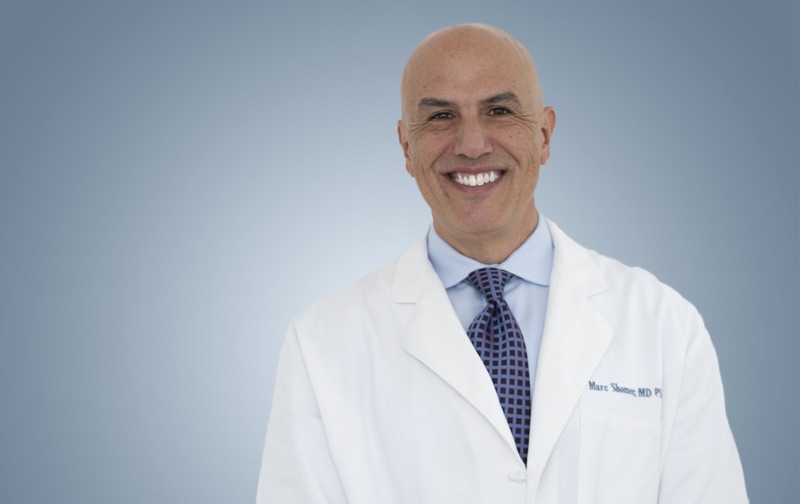
Marc H. Shomer, MD, PhD, QME, is board certified by the American Board of Ophthalmology (certified 2011, recertified 2021), a California Qualified Medical Evaluator, and an Adjunct Associate Professor of Ophthalmology at the Keck School of Medicine of USC (faculty since 2009). He has performed more than 20,000 eye surgical procedures and is licensed in California and Nevada. Full biography · Curriculum vitae
Published October 12, 2026 · Last substantive review October 12, 2026 · Medical reviewer: Marc H. Shomer, MD, PhD, QME
Request a Conflict Check and Case Review
Submit the matter for conflict screening. Please do not send medical records or protected health information until conflicts are cleared and secure transfer instructions are provided.